Bitcoin in TFSA Canada: The $0-Commission Crypto ETF Strategy for 2026
Four TSX-listed Bitcoin and Ethereum ETFs compared by MER, tracking error, and tax-free growth — plus the contribution room risk nobody talks about.
Disclosure: This article contains referral links. Compensation may be received at no cost to you — this does not influence our analysis or recommendations.

Capital gains on Bitcoin held outside a TFSA are taxable at your marginal rate. Inside? Permanently $0.
The Bottom Line: Raw crypto cannot go in a TFSA, but four TSX-listed spot Bitcoin and Ethereum ETFs are fully eligible. Wealthsimple trades them at $0 commission — banks charge $6.95-$9.99 per trade.
- FBTC has the lowest MER at 0.35% — one-quarter the cost of BTCC
- All gains inside the TFSA are permanently tax-free (no capital gains tax)
- Contribution room lost to a crypto crash never comes back — position sizing matters
Why can’t you hold raw Bitcoin in a TFSA?
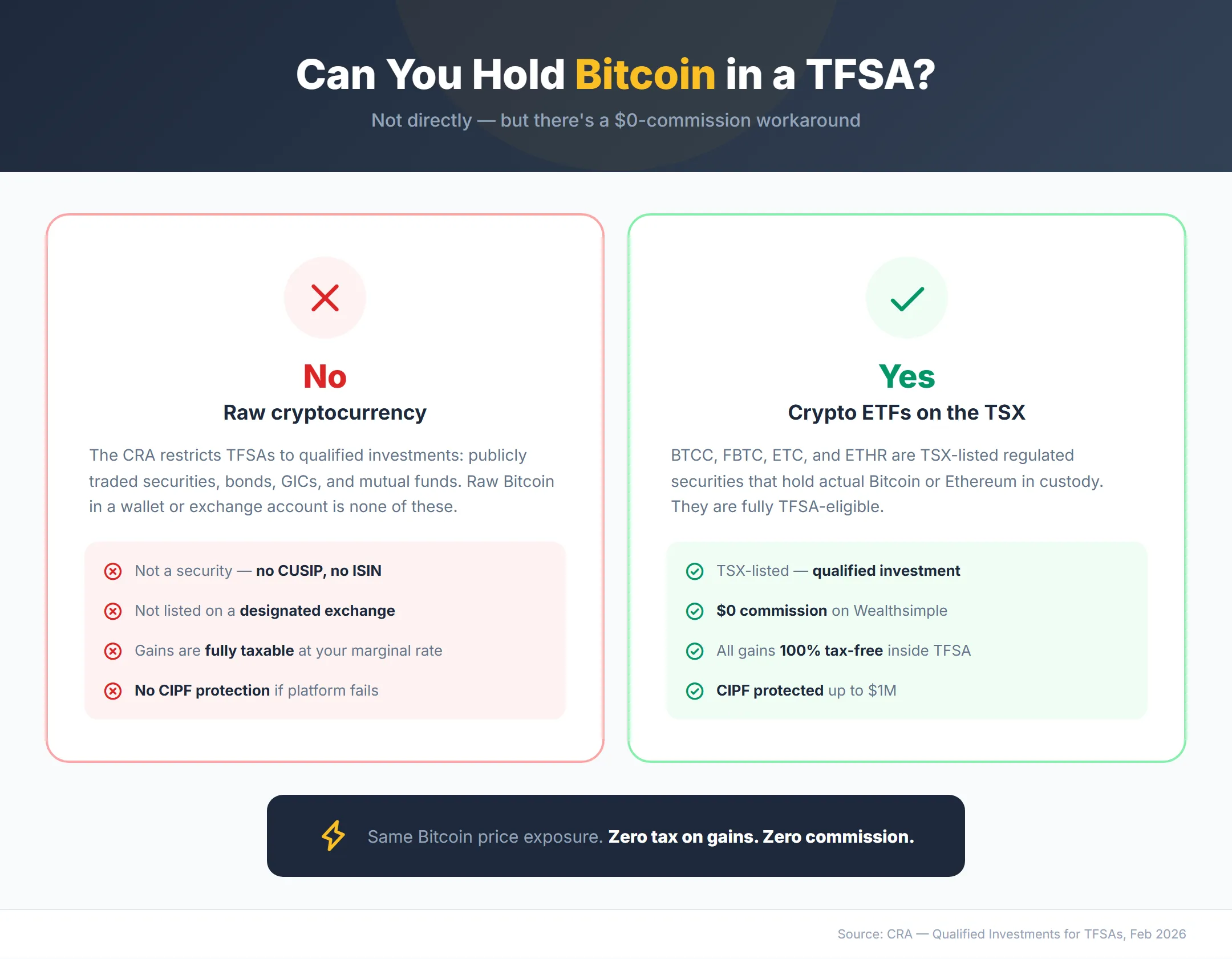
The CRA restricts TFSA holdings to qualified investments — publicly traded securities on a designated exchange, government bonds, GICs, and mutual funds. Raw cryptocurrency does not meet any of these criteria.1 Bitcoin sitting in a wallet or on a trading platform is not a security, not listed on a stock exchange, and has no CUSIP or ISIN identifier. It simply cannot go inside a registered account.
If you buy Bitcoin, Ethereum, or Solana through the Wealthsimple Crypto account, those assets are held in a non-registered taxable account. Capital gains from selling are taxed at a 50% inclusion rate on the first $250,000 of gains per year — meaning half of your profit gets added to your income and taxed at your marginal rate.2 For someone in a 33% bracket, a $10,000 gain on Bitcoin means roughly $1,650 in taxes. For a deeper look at how Wealthsimple Crypto compares to Newton and Shakepay for non-registered trading, see our platform comparison.
If you already hold Bitcoin in a Wealthsimple Crypto account, you cannot transfer it in-kind to your TFSA. You must sell the crypto to CAD (triggering a taxable event), wait for the funds to settle, then manually buy the ETF in your TFSA. There is no automated shortcut between the two account types.
There is also a critical risk specific to holding volatile assets like crypto ETFs in a TFSA: permanent loss of contribution room. If you invest $5,000 in BTCC and Bitcoin crashes 80%, selling at $1,000 means you have permanently destroyed $4,000 of tax-free space. You cannot claim a capital loss inside a TFSA to offset other gains, and the lost room never comes back. This asymmetry makes position sizing especially important for crypto ETF holdings.
Which crypto ETFs can you buy in a Wealthsimple TFSA?
Four TSX-listed spot cryptocurrency ETFs are available in a self-directed Wealthsimple TFSA and are fully TFSA-eligible as standard Canadian securities.
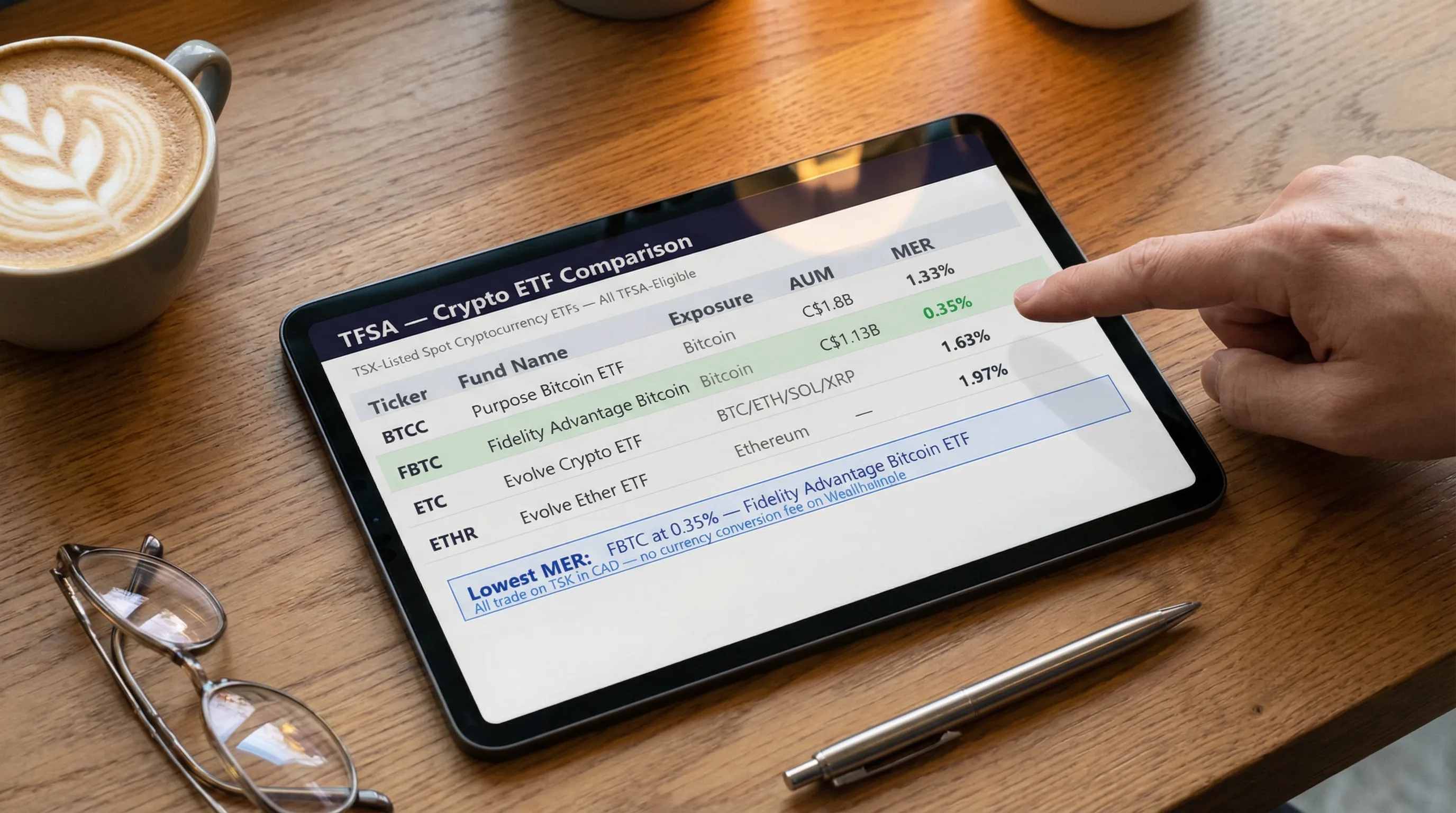
BTCC launched in February 2021 as the world’s first physically settled Bitcoin ETF — meaning the fund holds actual Bitcoin in cold storage rather than synthetic derivatives. FBTC offers a similar structure with institutional-grade liquidity through Fidelity.
According to Tony Dong, Certified ETF Analyst and Motley Fool Canada contributor, Canadian-listed crypto ETFs saw assets under management climb toward the $6 billion mark by end of 2025 — a “watershed year” for institutional crypto adoption in Canada.3
ETC provides diversified exposure across four cryptocurrencies in a single holding, and ETHR gives direct Ethereum exposure. FBTC stands out with the lowest MER of the group at 0.35% — unusually cheap for a crypto ETF.
Custody structure is another differentiator worth noting. BTCC uses third-party custodians like Gemini and Coinbase to hold its Bitcoin, while Fidelity’s FBTC clears its own trades and acts as its own custodian using institutional-grade cold storage. For security-conscious investors, this internal custody model avoids the counterparty risk of outsourced storage.
Because all four ETFs trade on the TSX in Canadian dollars, you never trigger Wealthsimple’s 1.5% currency conversion fee. That fee only applies when buying US-listed securities — a distinction that most guides about crypto in a TFSA overlook entirely. For the full breakdown of Wealthsimple TFSA fees and contribution limits, see our pillar guide.
One common point of confusion on Wealthsimple: Purpose offers both a CAD-hedged version (BTCC) and an unhedged version (BTCC.B). Currency hedging adds internal fund costs that drag on long-term performance, so many long-term holders prefer unhedged versions like BTCC.B or FBTC.
How much do banks charge to buy crypto ETFs versus Wealthsimple?
Wealthsimple charges $0 commission on every crypto ETF purchase, while TD, RBC, BMO, CIBC, and Scotia charge $6.95-$9.99 per trade — a cost structure that devastates dollar-cost averaging strategies.
Consider a straightforward DCA plan: investing $250 into BTCC every two weeks to build Bitcoin exposure gradually.
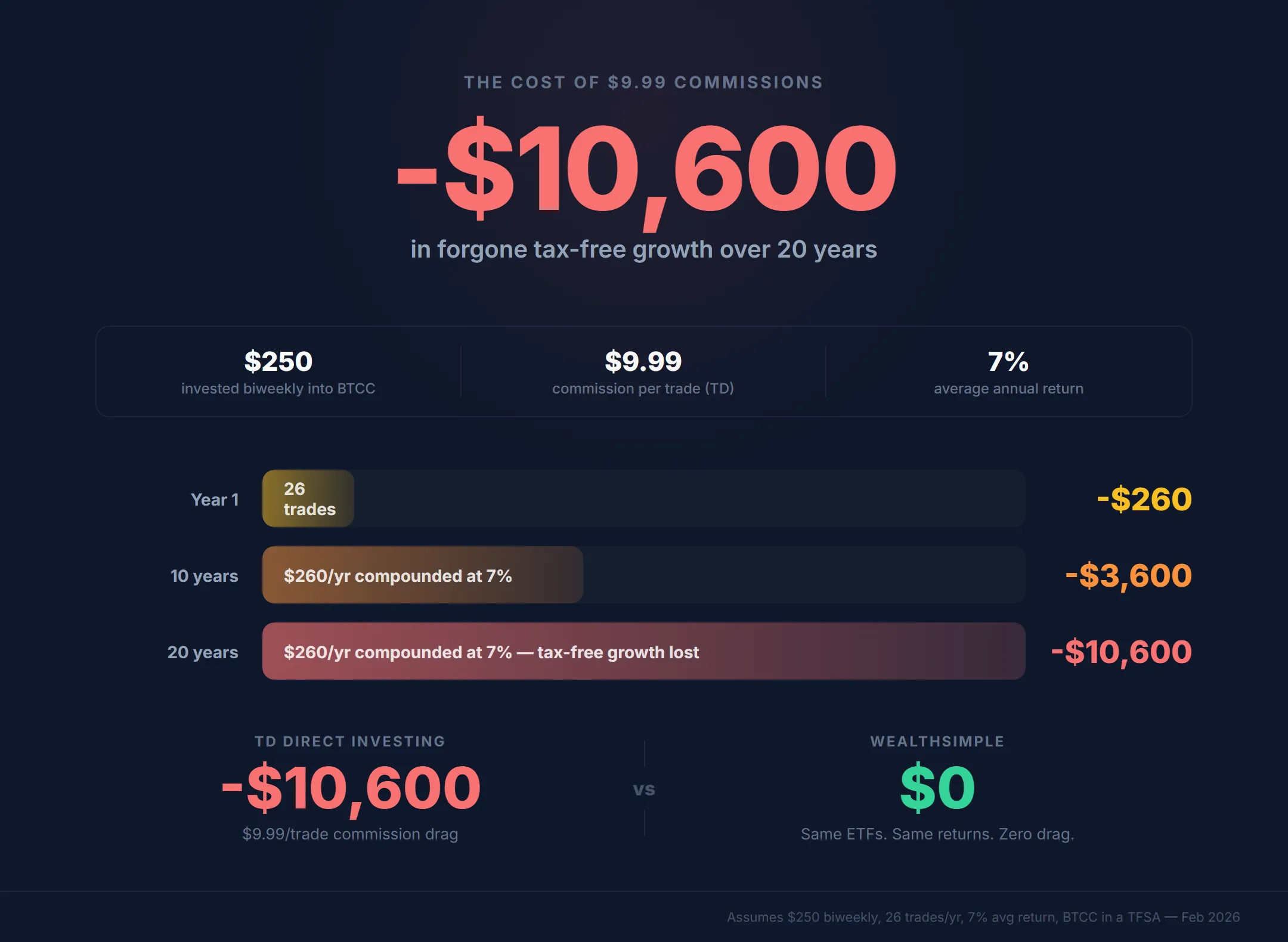
- At TD Direct Investing ($9.99/trade): Each $250 purchase loses $9.99 upfront — a 4% immediate capital loss before the ETF moves a single cent. Over a year, 26 trades cost $260 in commissions on $6,500 of contributions.
- At Wealthsimple ($0/trade): The full $250 goes to work every time. Zero commission drag.
Wealthsimple also supports fractional trading for both BTCC and FBTC, so your entire $250 goes into the market immediately — no leftover cash sitting idle because it could not purchase a full share. Most bank brokerages require whole-share purchases.
Over 10 years at a 7% annual return, that $260 per year in lost contributions compounds to roughly $3,600 in forgone tax-free growth.4 Over 20 years, it exceeds $10,600 — money that would have been entirely tax-free inside a TFSA.
Crypto ETFs already carry higher management expense ratios than standard index ETFs (0.35-1.97% versus 0.08-0.25% for something like XEQT). Adding $10 in commissions per trade on top of a 1% MER creates a double-cost drag that is particularly punishing for small, regular contributions. If you are currently buying crypto ETFs at a bank and want to switch, our bank-by-bank TFSA transfer guide covers fees, timelines, and Wealthsimple’s reimbursement policy.
What are the tax savings of crypto ETFs in a TFSA versus a taxable account?
A $10,000 Bitcoin position that doubles to $20,000 generates a $10,000 capital gain — fully tax-free inside a TFSA, but costing $1,650 to $2,500 in federal and provincial taxes in a non-registered account.
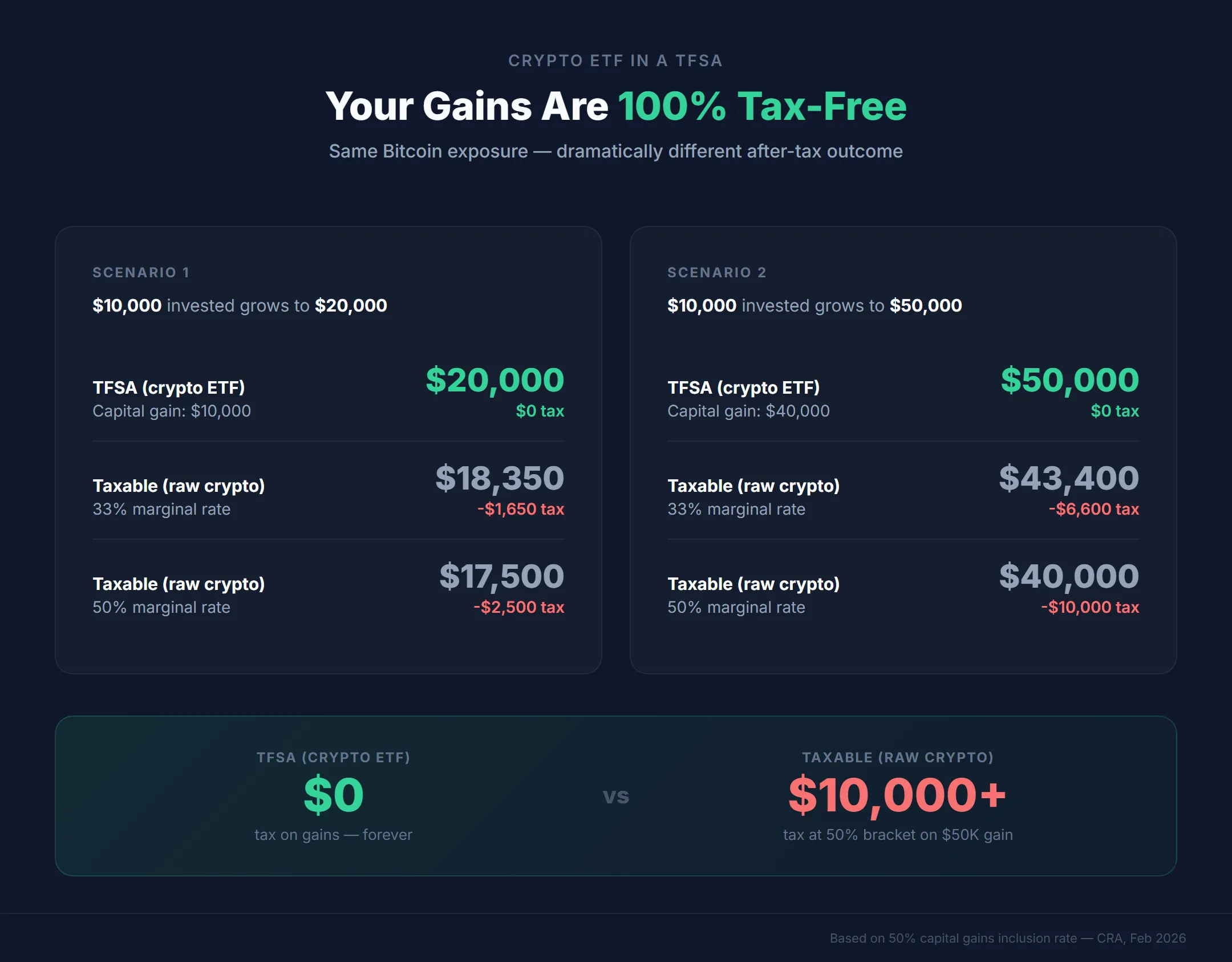
The math assumes the current 50% capital gains inclusion rate on the first $250,000 of annual gains.2 The tax applies only when you sell in a taxable account. Inside a TFSA, there is no taxable event at all — you can sell, reinvest, and compound without ever triggering a tax obligation.
The compounding scenario is where the TFSA advantage becomes dramatic. Suppose you contribute $500 per month to BTCC inside a Wealthsimple TFSA. After 10 years at a 15% annualized return (conservative relative to Bitcoin’s historical performance but aggressive relative to traditional equities), your portfolio reaches roughly $139,000 on $60,000 of contributions. The $79,000 gain would cost approximately $13,000 in taxes in a non-registered account at a 33% marginal rate. Inside the TFSA, you keep every dollar.
One important caveat: because crypto is highly volatile, it can be tempting to swing-trade these ETFs inside the TFSA. The CRA actively audits TFSAs for day-trading activity — if they classify your frequent trading as a business operation rather than passive investing, your gains lose their tax-free status and become fully taxable as business income. A buy-and-hold or DCA approach is significantly safer from a regulatory standpoint.
Even at a more conservative 7% return (standard equity assumption), the same $500 per month reaches roughly $87,000 after 10 years, sheltering about $4,400 in taxes that would otherwise be owed.
Cryptocurrency is the highest-volatility asset class most Canadians hold. That volatility cuts both ways, but it also means the TFSA shelter is proportionally more valuable for crypto than for stable dividend stocks. A TFSA holding XEQT at steady 7% saves predictable tax. A TFSA holding BTCC during a Bitcoin cycle could shelter 100%+ gains entirely.
There is a fundamental trade-off to acknowledge with this strategy: buying an ETF means purchasing paper exposure to Bitcoin’s price, not the asset itself. You cannot withdraw it to a hardware wallet or use it on the Bitcoin network. ETFs are strictly tax-sheltered price exposure — not true cryptocurrency ownership. However, that paper exposure comes with a significant security benefit: because BTCC and FBTC are regulated Canadian securities, holding them in a TFSA grants up to $1 million in coverage from the Canadian Investor Protection Fund (CIPF) if the brokerage fails. Raw crypto in the Wealthsimple Crypto account has no equivalent protection.
The Wealthsimple Crypto account provides the same price exposure, but with a 2% trading fee on Core tier and full capital gains taxation on every profitable trade. That 2% fee is a spread applied to both buying and selling — meaning you start every round-trip trade down roughly 4% before breaking even. For anyone dollar-cost averaging into crypto frequently, this spread compounds heavily compared to the $0 commission ETF route.
Does the US withholding tax affect crypto ETFs in a TFSA?
The 15% US withholding tax that affects US dividend-paying stocks in a TFSA is effectively irrelevant for crypto ETFs because Bitcoin and Ethereum generate no income — virtually all returns come from capital appreciation.5

The W-8BEN form governs US withholding tax on foreign investors — but crypto ETFs generate virtually no dividend income, making the withholding irrelevant for TFSA holders.
The Canada-US tax treaty does not recognize the TFSA as a retirement account, so US-source dividends paid inside a TFSA face a 15% withholding that cannot be recovered. This is a legitimate concern for investors holding US stocks or S&P 500 ETFs in a TFSA — an ETF like VFV with a 1.30% dividend yield loses about 0.19% per year to withholding, which costs roughly $7,000 over 30 years on a $50,000 portfolio.
But BTCC, FBTC, ETC, and ETHR hold raw cryptocurrency, not dividend-paying US corporations. Bitcoin and Ethereum produce no income distributions. Any proceeds from these ETFs come from selling the underlying crypto at a higher price — capital appreciation, not dividends. Capital gains are not subject to US withholding tax in any account type. The withholding concern that keeps some investors from using their TFSA for alternative assets simply does not apply here.
Is buying a Bitcoin ETF in your TFSA worth it?
You cannot hold raw Bitcoin in a TFSA, but you can buy BTCC, FBTC, ETC, or ETHR inside one — and Wealthsimple charges $0 to trade them, with no account fees and no inactivity penalties. The combination of zero commissions, zero currency conversion fees (TSX-listed, CAD-denominated), and complete tax-free sheltering makes a Wealthsimple TFSA one of the most efficient ways to get regulated Bitcoin exposure in Canada.
For the full fee comparison across seven banks, contribution room details, and the step-by-step account opening process, see the Wealthsimple TFSA Guide 2026. Start with a $25 cash bonus on your first deposit.
Frequently asked questions
Can you hold Bitcoin directly in a TFSA?
No. The CRA does not allow direct cryptocurrency holdings in any registered account. A TFSA can only hold qualified investments — publicly traded securities on a designated exchange, government bonds, GICs, and mutual funds. Raw Bitcoin, Ethereum, and other digital assets held on exchanges or in wallets are not qualified investments.
Are Bitcoin ETFs TFSA-eligible in Canada?
Yes. Spot cryptocurrency ETFs listed on the TSX — including the Purpose Bitcoin ETF (BTCC), Fidelity Advantage Bitcoin ETF (FBTC), Evolve Ether ETF (ETHR), and Evolve Cryptocurrencies ETF (ETC) — are standard regulated securities. They are fully TFSA-eligible and can be purchased in a self-directed Wealthsimple TFSA at $0 commission.
Does Wealthsimple charge fees to buy crypto ETFs in a TFSA?
No. Wealthsimple charges $0 commission on all Canadian-listed ETF trades, including crypto ETFs like BTCC and FBTC. The only ongoing cost is the ETF management expense ratio (MER), which ranges from 0.35% to 1.97% depending on the fund — charged by the fund provider, not Wealthsimple.
What is the difference between the Wealthsimple Crypto account and crypto ETFs in a TFSA?
Tax treatment. The Wealthsimple Crypto account holds actual digital assets (Bitcoin, Ethereum, Solana) but operates as a non-registered taxable account — all capital gains are taxable. Crypto ETFs held in a TFSA provide price exposure to the same assets, but all gains are permanently tax-free inside the TFSA shelter.
Do crypto ETFs pay dividends that trigger US withholding tax in a TFSA?
Crypto ETFs pay minimal or zero dividends because Bitcoin itself generates no income. The 15% US withholding tax that affects US dividend-paying stocks in a TFSA is therefore negligible or inapplicable for crypto ETFs. The vast majority of returns come from capital appreciation, which is fully tax-free in a TFSA.
How much does it cost to buy BTCC at a bank versus Wealthsimple?
$6.95-$9.99 per trade at a bank, $0 at Wealthsimple. A bi-weekly dollar-cost averaging strategy of $250 at TD Direct Investing costs $9.99 per trade — a 4% immediate loss. The same strategy on Wealthsimple costs $0 in commissions, preserving the full $250 for investment.
Sources
Footnotes
CRA — Tax-Free Savings Account (TFSA), Qualified Investments ↩
CRA — Capital Gains. The 2024 federal budget proposed increasing the inclusion rate to 66.7% on annual capital gains above $250,000 — this measure had not received royal assent as of February 2026. ↩ ↩2
Fee data compiled from published commission schedules at TD Direct Investing, RBC Direct Investing, BMO InvestorLine, CIBC Investor’s Edge, and Scotia iTRADE as of February 2026. ↩
Canada-US Tax Convention, Article XXI — the TFSA is not recognized as a “pension” under the treaty, so US-source dividends face 15% withholding (reduced from the statutory 30% via W-8BEN). Capital gains are not subject to US withholding regardless of account type. ↩

About the Author
Isabelle Reuben is a specialized finance writer focused on Canadian investment platforms and bonus optimization. With 5+ years tracking robo-advisors, she stress-tests Wealthsimple's features to transform fine print into actionable blueprints.