Wealthsimple RRSP Boost Review 2026: Is the ~4% Loan Worth It?
Wealthsimple launched the RRSP Boost — a flexible, asset-backed RRSP loan available directly in the app. Here's how it compares to traditional bank RRSP loans.
Disclosure: This article contains referral links. Compensation may be received at no cost to you — this does not influence our analysis or recommendations.
The Bottom Line: The RRSP Boost is an asset-backed line of credit at ~4% interest with flexible repayment. You can borrow 20-30% of your portfolio value to maximize your RRSP contribution, then use your tax refund to pay it down. Best for higher-income Canadians with existing investments and unused contribution room.
- Rates between 3.95% and 4.95% depending on your asset level
- No fixed payment schedule — repay monthly, lump-sum, or on your own timeline
- Only self-directed non-registered and TFSA accounts qualify as collateral
- Tax refund typically covers a significant portion of the loan
What is the Wealthsimple RRSP Boost?
Wealthsimple positions this product under a broader strategy they call the Retirement Accelerator — built on the concept of “Life Cycle Investing,” a theory developed by Yale professors that argues most people earn more money later in life, when there’s less time for compound growth to work.1 The idea is that borrowing to invest earlier — within reasonable limits — can produce better long-term retirement outcomes than waiting until you have the cash.
This isn’t a traditional bank loan. It’s a flexible line of credit backed by your existing assets, managed entirely within the Wealthsimple app. Announced at their “For Nerds Only” event in October 2025 and launched in Q1 2026, the RRSP Boost feature automates the contribution process — you select the amount to borrow and the destination RRSP account in one flow, so funds go directly where they need to.2
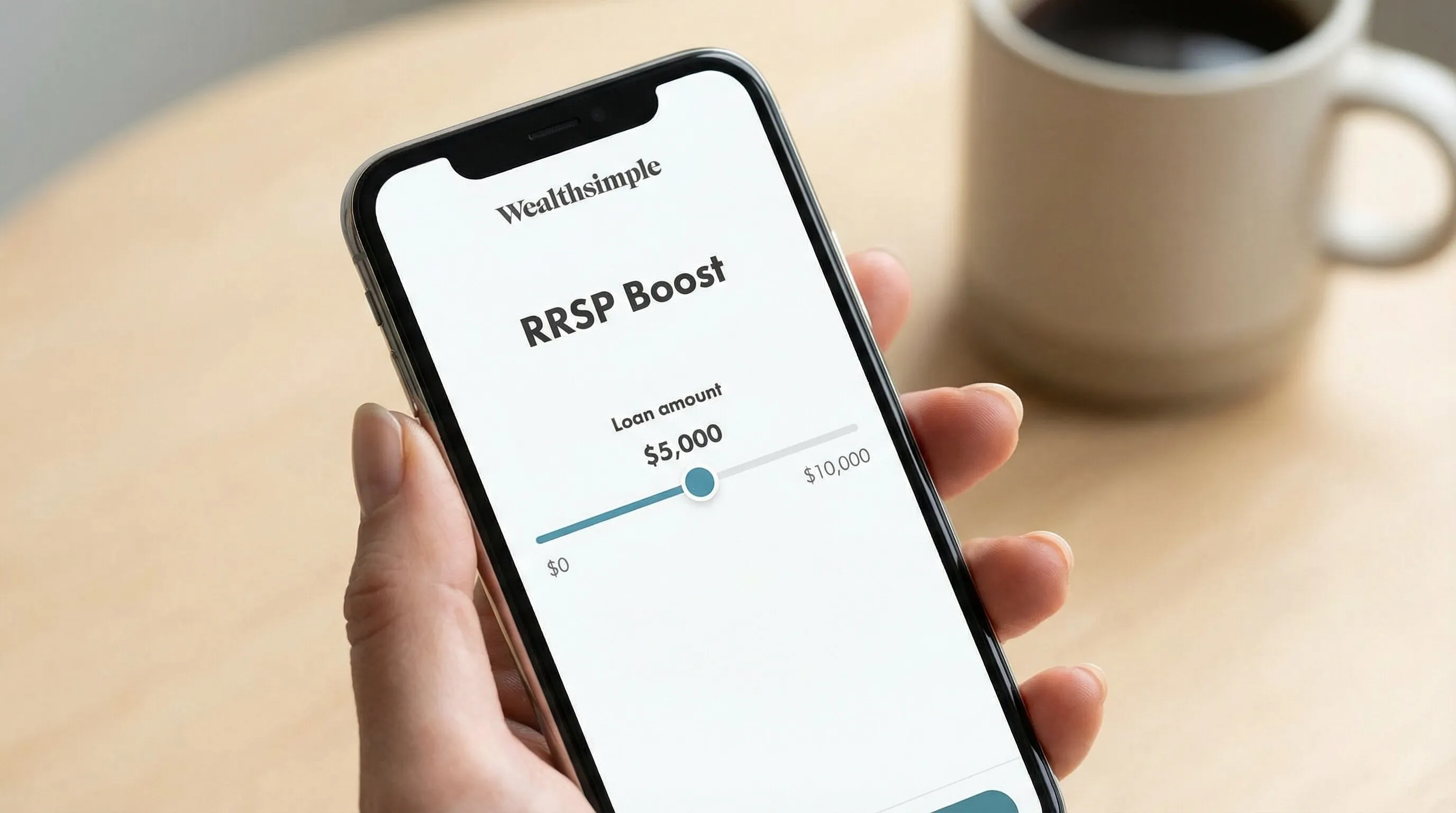
Wealthsimple’s RRSP Boost lets you borrow directly in the app to fund your contribution
| Platform | Bonus | Requirement | Code | Link |
|---|---|---|---|---|
| Wealthsimple | $25 | Deposit $100 | Apply ➔ |
How does the Wealthsimple RRSP Boost loan work?
The Wealthsimple RRSP Boost functions as an asset-backed loan that follows a specific lifecycle:
- You have eligible assets in a Wealthsimple non-registered account or TFSA
- You borrow against those assets to fund an RRSP contribution
- The RRSP contribution generates a tax deduction, reducing your taxable income for the year
- You use the tax refund (and/or other funds) to repay the loan
- Your RRSP grows from the larger contribution, ideally outpacing the loan interest over time
The loan amount depends on two factors: the value of your eligible assets and their volatility. One gotcha we’ve noticed: asset type matters immensely. Broad-market ETFs typically offer strong borrowing power, but some assets — like physical gold ETFs — may have 100% margin requirements, meaning they contribute nothing to your borrowing limit. If your portfolio is heavy on commodities or niche assets, your actual Boost limit may be much lower than expected.
Don’t expect a 1:1 match — Wealthsimple typically caps borrowing at roughly 20-30% of your portfolio’s value to buffer against market drops. In practice, this cap is fluid — your borrowing power can drop instantly when market volatility spikes. Unlike a bank loan that stays fixed, your available credit here breathes with the market. Be wary of the “Available to Borrow” number updating in real-time — we’ve seen patterns of users having their available margin spike incorrectly after rate changes, only to drop by 50% the next day once the system corrected itself. Never borrow up to the absolute limit shown in the app immediately after a market shift.
Crypto accounts also appear to be ineligible as collateral — if you hold most of your assets in Wealthsimple Crypto, you may have little to pledge. If your portfolio is heavily weighted in volatile assets (individual stocks, crypto ETFs, etc.), that cap will be even lower. More stable, self-directed portfolios (diversified ETFs, index funds) qualify for higher borrowing amounts. Note that Wealthsimple’s Managed Investing accounts are not eligible as collateral — only self-directed non-registered and TFSA accounts qualify.2 If your investments are currently in a Managed account, you’d need to switch to Self-Directed first, which can take several business days.
One detail worth noting: the RRSP Boost runs on the same infrastructure as Wealthsimple’s Portfolio Line of Credit. If you’re already using margin borrowing in your non-registered account, the Boost shares that same borrowing capacity — your available loan amount is reduced by whatever you’ve already borrowed. This also means you can’t use the same account to back both a standard margin position and an RRSP Boost loan simultaneously — if your TFSA or non-registered account is already linked as margin collateral, you’ll need to delink it before it becomes eligible for the Boost.

Traditional bank RRSP loan paperwork versus instant approval in the Wealthsimple app
What interest rate does the Wealthsimple RRSP Boost charge?
The RRSP Boost charges interest rates between 3.95% and 4.95%, depending on your asset level and portfolio composition. These rates are tied to the Bank of Canada’s overnight rate and will fluctuate as the BoC adjusts its policy rate — see how this compares to other platforms’ RRSP promotions.2
For context, here’s how that compares to traditional RRSP loans:
| Lender | RRSP Loan Type | Approximate Rate (early 2026) | Repayment Structure |
|---|---|---|---|
| Wealthsimple | Asset-backed line of credit | 3.95% – 4.95% | Flexible (no fixed schedule) |
| CIBC | Unsecured personal loan | Prime + 1% (~5.45%) | Fixed monthly payments |
| TD | Unsecured personal loan | Prime + 1-2% | Fixed monthly payments |
| RBC | Unsecured personal loan | Prime + 1-2% | Fixed monthly payments |
Wealthsimple: 3.95% – 4.95%. Asset-backed line of credit. Flexible repayment.
Big bank RRSP loans (CIBC, TD, RBC): Typically prime + 1-2% (~5.45%+). Unsecured personal loans. Fixed monthly payments.
Wealthsimple’s rate is generally lower because the loan is secured — backed by your existing investments. Bank RRSP loans are typically unsecured personal loans, which carry higher rates because the bank has no collateral.
One important caveat: interest paid on a loan used to fund a registered account (RRSP or TFSA) is not tax-deductible. This differs from borrowing to invest in a non-registered account, where the CRA allows you to deduct the interest. Factor this into your cost calculation — the loan interest is a pure cost, not a write-off.
Is there a fixed repayment schedule for the RRSP Boost?
The Wealthsimple RRSP Boost offers flexible repayment options with no fixed schedule or early payment penalties.
Traditional bank RRSP loan: Fixed monthly payments over a set term (typically 12 months). Miss a payment and you face penalties. The bank wants the loan repaid on a rigid schedule.
Wealthsimple RRSP Boost: Flexible repayment with multiple options:2
- Monthly payments if you prefer a structured approach
- Lump-sum payments (e.g., using your tax refund)
- Ad hoc payments on your own schedule
- No early repayment penalties — pay it off whenever you want
Wealthsimple expects that most clients will use their RRSP tax refund to pay down or eliminate the loan.2 This creates a natural cycle: borrow to contribute, get the tax deduction, receive the refund, repay the loan.
When does borrowing to contribute make sense?
Borrowing to contribute makes the most sense when you have a high marginal tax rate and immediate plans to repay the loan. Not sure what your marginal rate is? Use our RRSP calculator to see your exact refund by province.
It makes sense when:
- Your marginal tax rate is high enough that the RRSP deduction produces a meaningful refund
- You have unused contribution room that you can’t fill with cash alone
- Your investment returns are likely to exceed the loan interest rate over time
- You plan to use the tax refund to repay the loan quickly
- You have stable existing investments to serve as collateral
Case Study: How a $15,000 Loan Increases Your Refund
This example demonstrates how leveraging the loan can generate a net positive refund for a middle-income earner.
Sarah, 32, earns $95,000/year:
- Marginal tax rate: ~30% combined (federal + Ontario)
- Available cash for RRSP: $10,000
- Unused RRSP contribution room: $25,000
- Wealthsimple TFSA balance: $40,000 (diversified ETFs)
Without the RRSP Boost, Sarah contributes $10,000 and gets a ~$3,000 tax refund.
With the RRSP Boost, Sarah borrows an additional $15,000 against her TFSA holdings and contributes $25,000 total:
- Tax refund on $25,000: ~$7,500
- Loan interest (assuming 4.5% for 4 months until refund): ~$225
- She applies the $7,500 refund to the loan, reducing the balance to ~$7,725
- She pays the remaining ~$7,725 over the following months from regular savings
The refund doesn’t cover the full loan — but it cuts it roughly in half. Sarah still comes out ahead: she received $4,500 more in tax refund than she would have without the Boost ($7,500 vs. $3,000), and the extra $15,000 in her RRSP starts compounding years earlier. The trade-off is carrying ~$7,725 in loan balance until she pays it down.
Is borrowing better than waiting to save cash?
Wealthsimple’s strategy relies on Life Cycle Investing, a theory suggesting that borrowing to invest early often outperforms waiting.1 If Sarah waited 5 years to accumulate the extra $15,000 in cash, she’d lose 5 years of compound growth on that money inside her RRSP.
At a conservative 6% average annual return:
- $15,000 invested now grows to ~$20,073 in 5 years
- $15,000 invested in 5 years is still just $15,000
The difference: ~$5,073 in additional growth, minus the ~$225 in loan interest. The math favours borrowing early — provided you actually repay the loan promptly and your investments perform reasonably over time.
This doesn’t account for market risk. Because the loan is secured by your collateral portfolio (TFSA or non-registered), a significant market drop in those holdings — not just your RRSP — can trigger a margin call. If your collateral value falls below the required threshold, Wealthsimple can liquidate positions automatically — and the system prioritizes liquidity, not your preferences for which holdings to sell. Don’t expect a warning phone call — margin calls are immediate actionable requests with no leeway. If your collateral drops sharply, the system can liquidate assets the same day. Even a small interest charge posting to a maxed-out account can trigger this liquidation instantly — the system is automated and won’t wait for you to deposit cash. If you see a negative balance notification due to a rejected deposit, check it immediately — Wealthsimple’s system may give you only until 11:59 PM that same day to resolve it before auto-liquidation kicks in. This cross-portfolio risk is the main downside of an asset-backed approach versus an unsecured bank loan where only your credit score is at stake.
How do you apply for the Wealthsimple RRSP Boost?
The RRSP Boost is available through the Wealthsimple app. The process involves working with a Wealthsimple adviser who walks you through eligibility, loan sizing, and the contribution.2
Requirements:
- A Wealthsimple account with eligible assets (non-registered or TFSA) to serve as collateral
- Available RRSP contribution room
- An existing Wealthsimple RRSP (or you open one during the process)
If you’re moving assets to Wealthsimple specifically to use as collateral, be aware of transfer timelines — account transfers can take 2-4 weeks to fully settle. During this time, your assets are in transit and cannot secure the loan, potentially causing you to miss the RRSP deadline if you cut it too close.
Which Wealthsimple promotions stack with the RRSP Boost?
The RRSP Boost is a lending product, not a promotion — but the RRSP contribution it funds is eligible for Wealthsimple’s other offers:
- Referral bonus: $25 cash for new account signups
- Wealthsimple 1% Match 2026: 1% cash match on transfers of $25,000+ paid as 24 monthly payments3
See the full breakdown of stackable promotions on our promotions page, or estimate your total with the Wealthsimple referral bonus calculator.
| Platform | Bonus | Requirement | Code | Link |
|---|---|---|---|---|
| Wealthsimple | $25 | Deposit $100 | Apply ➔ |
Summary
The RRSP Boost is a genuinely new product category for Canadian fintech — an app-based, asset-backed RRSP loan with flexible repayment and competitive rates. It’s not for everyone, and borrowing to invest always carries risk. But for higher-income Canadians with existing investments and unused contribution room, the math can work strongly in their favour.
If you’re focused on the immediate March 2 deadline, start with our RRSP deadline guide. If you’re comparing platform promotions, see our RRSP match comparison.
Frequently Asked Questions
What is the Wealthsimple RRSP Boost?
The RRSP Boost is Wealthsimple’s asset-backed RRSP loan product, part of what they call the Retirement Accelerator. It lets you borrow against eligible investments in your non-registered or TFSA accounts to make a larger RRSP contribution than you could with cash alone.
What are the interest rates on the Wealthsimple RRSP Boost?
Interest rates range from approximately 3.95% to 4.95%, depending on your asset level and composition. These rates fluctuate with the Bank of Canada overnight rate and may change over time.
What collateral is required for the RRSP Boost?
You need eligible assets in a non-registered Wealthsimple account or TFSA. The loan amount depends on the value and volatility of your holdings. Highly volatile assets may not qualify as collateral.
How do you repay the Wealthsimple RRSP loan?
Repayment is flexible. You can make monthly payments, lump-sum payments, or pay on an ad hoc basis. There are no penalties for early repayment. Many clients use their RRSP tax refund to pay down the loan.
How is the Wealthsimple RRSP Boost different from a bank RRSP loan?
Traditional bank RRSP loans are unsecured personal loans with fixed repayment schedules. Wealthsimple’s RRSP Boost is a flexible line of credit backed by your existing investments, with no fixed payment schedule and no early repayment penalties.
Is the Wealthsimple RRSP Boost available now?
Yes — the product launched in Q1 2026 as announced at the For Nerds Only event in October 2025. We accessed the feature directly through the Wealthsimple app, though it did require a brief sign-off from a Wealthsimple adviser during the setup flow.
Sources
Footnotes

About the Author
Isabelle Reuben is a specialized finance writer focused on Canadian investment platforms and bonus optimization. With 5+ years tracking robo-advisors, she stress-tests Wealthsimple's features to transform fine print into actionable blueprints.